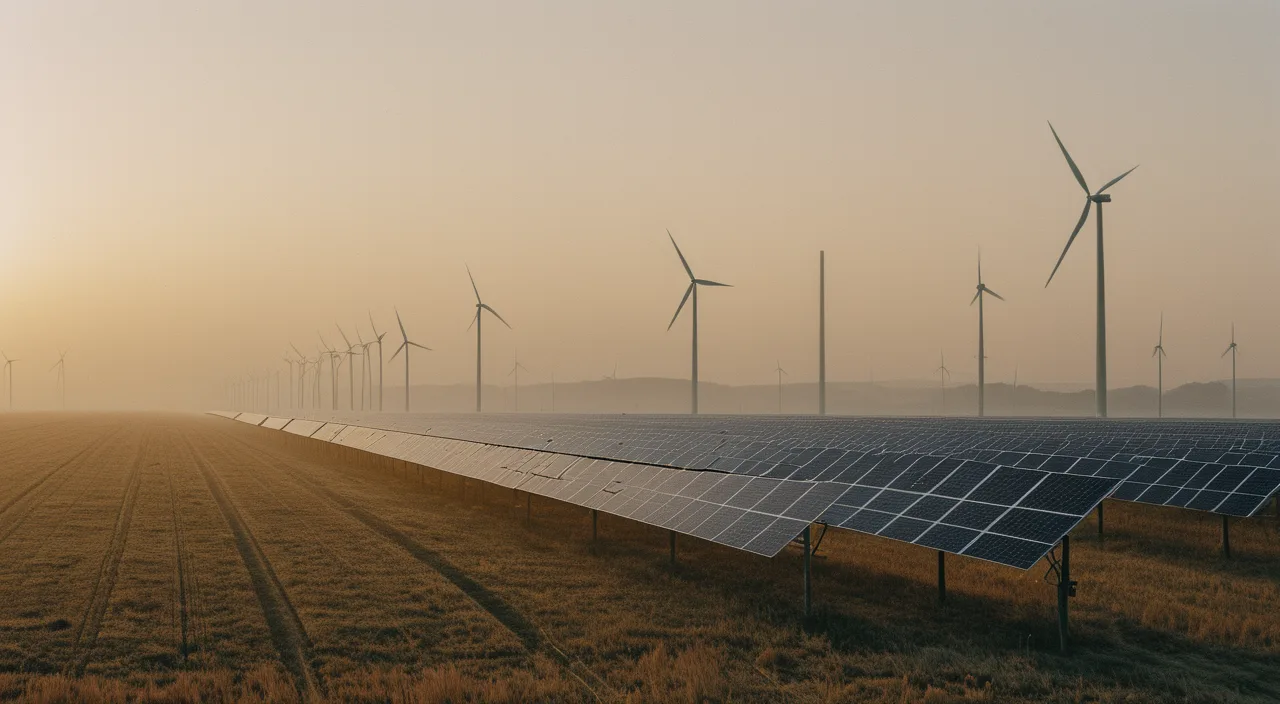
The 2050 energy picture has two readings worth holding side by side. The IEA Net Zero pathway describes what the world must do to keep 1.5°C alive. BNEF\'s 2026 outlook describes what is most likely on current dynamics. Both agree that renewables dominate by 2050. They disagree on the speed and on whether 1.5°C is still feasible.
What share of energy will renewables supply in 2050?
IEA\'s Net Zero pathway requires renewables to supply about 90% of global electricity by 2050, with wind and solar together about 70%. BNEF\'s Economic Transition Scenario, closer to a current-trajectory forecast, reaches about 70% from renewables. The first is what is needed; the second is what is likely.
| Claim | Source | Scenario | Confidence | On-track |
|---|---|---|---|---|
| Renewables share of global electricity in 2050 (IEA NZE pathway) | IEA NZE | NZE pathway | high | Off |
| Renewables share in 2050 (BNEF Economic Transition Scenario): ~70% | BNEF NEO 2024 | BNEF ETS | medium | Slipping |
| Solar becomes largest electricity source ~2032 | BNEF NEO 2026 | BNEF ETS | medium | On |
| EVs at ~2/3 of new car sales by 2030 (NZE pathway) | IEA NZE Roadmap | NZE pathway | medium | Off |
| Oil demand declines ~75% by 2050 (90 mb/d → 24 mb/d) under NZE | IEA NZE | NZE pathway | medium | Off |
| Global electricity demand rises ~69% by 2050 | BNEF NEO 2026 | BNEF ETS | medium | On |
Solar takes the top slot around 2032
BNEF\'s New Energy Outlook 2026 projects solar overtaking every other source to become the world\'s largest single source of electricity generation around 2032. The driver is unrelenting cost decline (utility-scale solar plus storage now competes with new gas in most of the world) and the speed of deployment in China, India, the United States and the European Union. Global electricity demand rises about 69% by 2050 per BNEF, and roughly two thirds of that new demand is met by electricity rather than direct fossil combustion.
Oil, gas and coal: decline curves under NZE
The IEA Net Zero pathway has oil demand falling about 75% by 2050 (from ~90 mb/d in 2020 to about 24 mb/d), unabated coal falling about 98%, and natural gas dropping to roughly 900 bcm. These are pathway numbers, not forecasts; they describe the decline rate required to keep 1.5°C in reach. BNEF\'s ETS has shallower declines because it tracks observed dynamics, while its Net Zero Scenario tracks closer to IEA\'s numbers.
EVs by 2030 and 2050
The 2030 milestone is the test. The IEA NZE requires EVs at about two thirds of new car sales by 2030; current sales are well below that share in most markets except China. BNEF\'s Net Zero pathway implies full phase-out of combustion engine vehicle sales by 2034 (sales, not stock). Real-world phase-out dates from major manufacturers and governments range from 2030 (some EU member states for new sales) to 2040 (US national target tied to incentives). The 2050 picture has the global light-vehicle fleet nearly all electric, with internal-combustion remnant fleets concentrated in low-income markets.
Fusion in 2050: a small but real role
ITER targets deuterium-tritium operations around 2035, with the project explicitly framed as a science demonstration, not a grid contribution. Private fusion ventures (Commonwealth Fusion Systems\' SPARC, TAE, Helion, Tokamak Energy) target mid-to-late 2030s for grid demonstrations of a few hundred megawatts. A realistic 2050 picture has fusion as a single-digit contribution to global generation, attractive for baseload roles in markets that struggle with renewable variability.
The investment gap
IEA NZE estimates clean energy investment must reach about USD 4.5T per year by 2030, roughly triple the 2025 level. BNEF tracks USD 2.0T in actual 2024 investment. The gap to NZE is large; the gap to BNEF\'s ETS is much smaller and is closing. The bottleneck is no longer cost; it is transmission, permitting, and grid build.
Frequently asked
What share of energy will renewables supply in 2050?
Two answers worth distinguishing. The IEA Net Zero pathway requires renewables to supply about 90% of global electricity in 2050 (wind and solar together about 70%). BNEF's Economic Transition Scenario, which is closer to a current-trajectory forecast, gets to about 70% of power generation from renewables by 2050. The first is what is needed; the second is what is most likely.
When does solar overtake coal as the largest electricity source?
BNEF's 2026 New Energy Outlook projects solar becoming the world's largest source of electricity generation around 2032, then continuing to grow. This is one of the few "on track" 2050 trajectories on the dashboard.
Will we still use oil in 2050?
Yes, but far less. The IEA Net Zero pathway has oil demand falling about 75% from 2020 (~90 mb/d) to 2050 (~24 mb/d), concentrated in petrochemicals and aviation. BNEF's Economic Transition Scenario shows a slower decline. Both reject "oil dead by 2030", which has no institutional support.
How many EVs will there be by 2050?
IEA NZE requires EVs at about two thirds of new car sales by 2030 and effectively the entire light-vehicle fleet by mid-century. BNEF's Net Zero pathway implies full phase-out of combustion engine vehicle sales by 2034 (note: sales, not the existing fleet). Neither is currently on track at the 2030 milestone.
Will fusion energy be commercial by 2050?
Maybe, for niche grid roles. ITER targets first plasma experiments around 2035; private projects (Commonwealth Fusion Systems' SPARC, TAE, Helion) target mid-to-late 2030s for grid demonstrations. A realistic 2050 picture has fusion as a small contribution to global generation, not a replacement for renewables.
What does the energy transition cost?
IEA Net Zero estimates annual clean energy investment must triple from about USD 2.4T in 2025 to roughly USD 4.5T by 2030, reaching about USD 5T per year in the 2030s. BNEF tracks USD 2.0T in actual 2024 investment; the gap to NZE is large but not unprecedented.