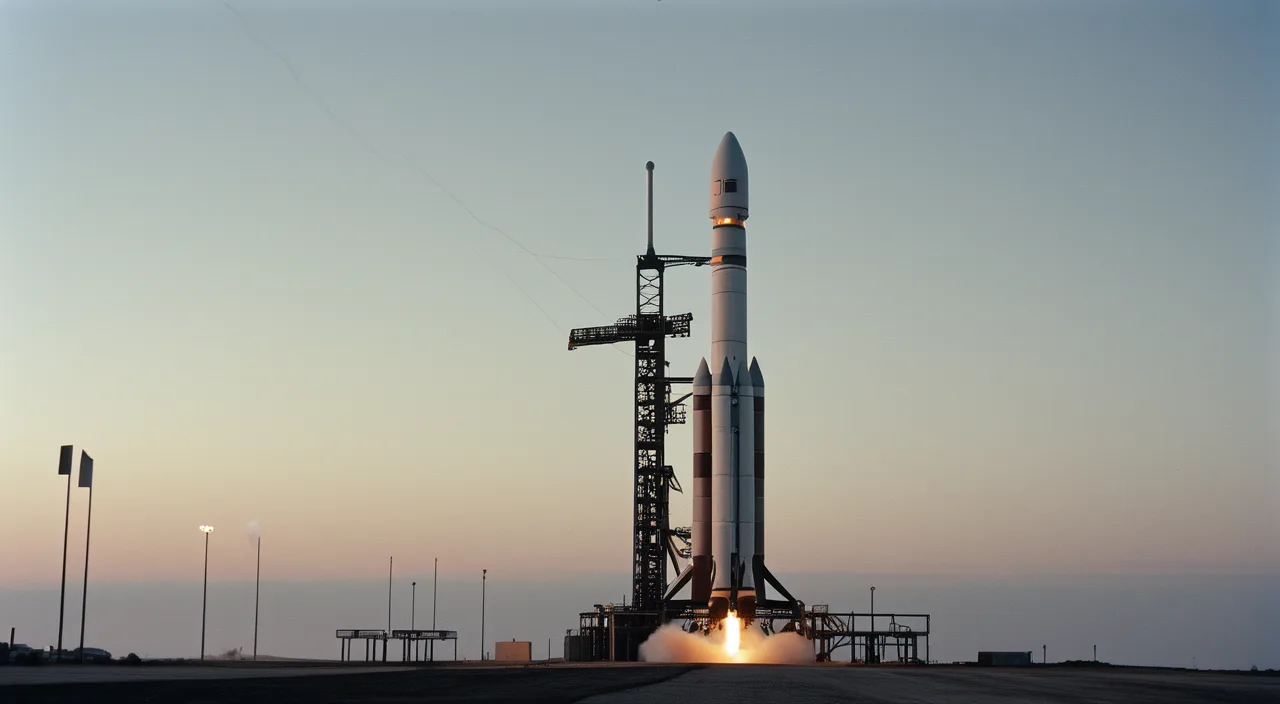
The 2050 space narrative gets two readings wrong in opposite directions. One side overstates Mars: "colony by 2030, city by 2050". The other understates the Moon: "Artemis is theatre, nothing real will happen". NASA\'s actual roadmap sits between them. Moon is real and dated. Mars is a horizon. The civilian space economy continues compounding.
Will humans live on Mars by 2050?
Not according to NASA\'s Moon-to-Mars architecture. Mars is treated as a horizon goal beyond the late 2030s; a crewed Mars mission by 2050 would require both Artemis success and a Mars-specific architecture that does not yet exist. SpaceX targets are not government roadmaps.
| Claim | Source | Scenario | Confidence | On-track |
|---|---|---|---|---|
| Artemis IV (first Artemis crewed lunar landing) targeted | NASA | NASA roadmap | high | Slipping |
| Mars remains a horizon goal; no crewed mission foreseen by 2050 | NASA Moon-to-Mars | NASA roadmap | high | On |
| Global space economy ~USD 1.8T by 2035 | McKinsey / WEF Apr 2024 | baseline | medium | On |
| Roughly 60+ countries operating satellites by 2030 | WEF / industry estimates | baseline | medium | On |
| Suborbital tourism continues; orbital tourism remains niche | Industry/regulatory data | baseline | medium | On |
NASA\'s actual Artemis plan in 2026
The Artemis program is the spine of US human spaceflight through the 2030s. After Administrator Jared Isaacman\'s February 2026 reprofiling, the sequence is: Artemis III (2026) becomes an Earth-orbit Human Landing System test rather than a lunar landing; Artemis IV (targeted early 2028) becomes the first crewed Artemis lunar landing. Artemis V and beyond are planned for the late 2020s and early 2030s. NASA\'s Mars architecture remains aspirational.
Why Mars is a horizon goal, not a 2050 destination
Three constraints. First, no NASA program of record builds a Mars transit vehicle, a Mars surface habitat, or a Mars ascent vehicle. Second, life-support and radiation shielding for a 6-9 month transit each way are unsolved engineering challenges, not budget questions. Third, the political commitment that produced Apollo within a decade does not exist for Mars. SpaceX\'s Starship architecture could in principle accelerate this, but private cargo-and-crew delivery does not equal a sustained crewed Mars program. By 2050, expect Mars sample return (US/EU), more robotic exploration, and possibly the start of a crewed Mars architecture, not a settlement.
Moon bases: small, semi-permanent, multi-national
NASA\'s Artemis Base Camp planning targets a sustained surface presence in the 2030s, beginning with short crewed missions and progressing toward longer stays. China\'s International Lunar Research Station targets a robotic-led base by the early 2030s and a crewed one later. By 2050, expect multiple national lunar programmes with rotating crews of a handful each, not Asimov-style settlements.
The civilian space economy compounds
McKinsey and the WEF project the global space economy at about USD 1.8 trillion by 2035, up from roughly USD 630 B in 2023. Most growth is in downstream satellite services: connectivity (Starlink and successors), Earth observation, positioning. Launch is a small fraction. The 2050 number is not directly forecast by major institutions; the trajectory implies a multi-trillion-dollar economy concentrated in services rather than hardware.
Space tourism: real, but not common
Suborbital tourism continues at modest volumes. Orbital tourism remains a luxury niche through 2050 in every credible institutional forecast. Even with Starship-class vehicles reaching reliability, the binding constraints are regulatory (FAA licensing), medical (acceleration and microgravity training), and economic (orbital flights remain expensive enough that consumer adoption is capped). Expect dozens to hundreds of orbital tourists per year by 2050, not thousands.
Frequently asked
Will humans land on Mars by 2050?
Not according to NASA's current Moon-to-Mars architecture. Mars is treated as a horizon goal beyond the late 2030s. The Artemis program is the prerequisite sequence: Moon return first, Mars architecture demonstrated, then crewed Mars in the late 2030s at earliest, more plausibly the 2040s. SpaceX targets are far more ambitious but are not government roadmaps.
When does NASA return crew to the Moon?
Artemis IV, the first Artemis crewed lunar landing under the revised plan, is targeted for early 2028. Artemis III, originally a landing mission, was reprofiled in February 2026 to a 2026 Earth-orbit Human Landing System test. Artemis launch dates have historically slipped, so treat all dates as targets, not commitments.
How big will the space economy be in 2050?
McKinsey and the World Economic Forum project the global space economy at about USD 1.8 trillion by 2035 (vs roughly USD 630 B in 2023). The 2050 figure is not directly forecast by major institutions but the trajectory implies a multi-trillion-dollar economy, with most growth in satellite services, Earth observation and broadband connectivity.
Will there be Moon bases by 2050?
Probably small, semi-permanent ones. NASA's Artemis Base Camp planning targets a sustained surface presence in the 2030s. China's International Lunar Research Station programme targets a robotic-led base by the early 2030s and a crewed one later. By 2050, expect multiple national programmes with rotating crews, not large permanent settlements.
Will space tourism be common by 2050?
Suborbital tourism continues at modest volumes; orbital tourism remains a luxury niche through 2050 in every credible institutional forecast. Costs may fall meaningfully (Starship-class vehicles, if reliable) but regulatory, training and medical barriers cap volumes.
Who are the major space programmes by 2050?
NASA, ESA, JAXA (Japan), China's CNSA, India's ISRO, plus a growing private sector (SpaceX, Rocket Lab, Sierra Space, Blue Origin, plus Chinese and European private launch providers). Russia's Roscosmos role uncertain.